
|
[ Resources ][ Shipping
Weights ][ Tech Tips ][ Boat
Show Schedule ][ Literature ]
Tech Tip
YACHT RODS/BOOM VANGS
Forespar® makes three sizes of spring loaded boom
vangs for boats starting around 30 feet and up to about 55 feet. These
units are rugged, a good value, and have many thousands of ocean miles
under hundreds of boats all over the world. We do not offer the most purchase
or have any “locks” or fancy stuff. These are work horses designed to
do the job on a general cruising boat or club racer. They will work very
effectively if installed correctly and not abused. Some basic points to
remember:
- The boom must be fixed, non-rotating and non-sliding on the mast.
Roller booms or sliding goosenecks will not work with any
rigid vang. The boom fitting or the upper vang head will fail if
the boom can “roll”.
- The minimum angle from the boom should not be less than 30 deg.
and no more than 45 deg. Lesser or greater angles increase the compressive
load beyond what a spring- loaded vang can handle. Hydraulics is
the only answer beyond these angles.
- Yacht Rods do not “lift” the boom. Only hydraulics can do that.
These do take the place of a topping lift. They will hold
the boom up while dropping sails or reefing. Properly set up, they
will keep the boom level when the main is furled.
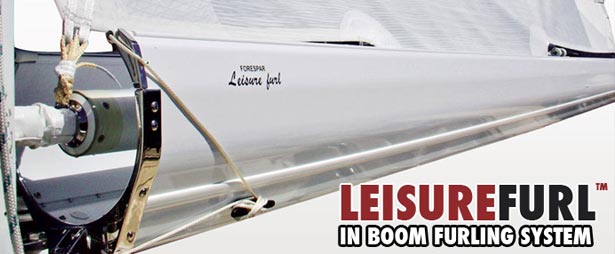
- Do not attempt using a standard spring-loaded vang
with an in-boom furling system. These furling units are far heavier
than a standard boom and these vangs are not suited for this type
of boom.
- The “stroke” is the total maximum compressed travel of the spring/piston.
Once the spring bottoms out, the unit will fail if further compressive
force is applied. We offer a minimum of 7” on the medium Yacht Rod
and 11-1/2” on the large and extra large units. This should be plenty
of travel. If, on an average 40’ cruiser, they need to “vang” the
main down more than 7”, the sail is cut wrong!
We make mast and boom brackets
to fit our ends. We require that they be used. They
must handle a tremendous compression force and still articulate in
line with the boom. They are every bit as critical as the booms gooseneck.
The boom fitting must fit snugly to the vang end and “spread” the
load on the boom. This fitting sees compression and tension. The boom
attachment must be capable of handling these forces without kinking
the boom. A lot of race boats loose their booms due to failure at
the vang fitting.
Rigid vangs can rattle, squeak, or make other noises under sail. They
all do to some degree. We cannot guarantee ours will be completely
quite, but from the hundreds of installations in the field, we are
not hearing of any major noise problems. Do not oil these! The oil
will simply flow out and end up on deck. Keep them clean by flushing
with fresh water periodically. No other maintenance should be needed
other than watching for worn line, dents or bends. Do not use a unit
that has been damaged or over-compressed.
Common care should keep the Yacht Rod working for many years and nautical
miles.
Sizing
yacht rod boom vangs
Choosing the correct size rigid vang requires the following information:
- Distance from mast fitting to boom fitting at the proper angle
from the boom per the previous spec sheet. This will tell you what
length requirements you have for using the “pin to pin” dimensions
on the Yacht Rod size chart. (Found in the 2001 Forespar® catalog,
page 20) Note that it is possible to have a low boom on a large
boat that makes this dimension inaccurate. Be sure to check angle
and length.
- Be sure you do not have any obstructions (hatches, vents, cabin
tops) in the way of the Yacht Rod’s arc of movement. Remember that
it will need clearance through 180 degrees of movement from side
to side.
- Check above dimensions against the catalog’s boat size recommendations.
If you are close to the maximum, you may need to go up a size to
support your boom and sails weight at rest. (Furled) Do not undersize!
- Install mast fitting as low as possible on aft centerline of mast.
- Install boom fitting to get proper angle per previous specs sheet.
You may want to clamp the boom fitting in place first, before you
drill any holes; to be sure it is in the correct position. This
way, you can ease the weight of the boom and furled main sail onto
the unit to find out how much the spring will be compressed at rest.
- Adjust the cross pin as needed being sure the spring is between
the pin and the inner piston tube. Do not set the pin through the
spring!
- Whenever the sail is furled, it is best to set the main halyard
to the outboard end of the boom to support the booms weight. In
this way, the Yacht Rod spring will not take a “set” from being
compressed the whole time the boat is not in use.
Basic sizing:
34-40 feet- Yacht Rod Medium #352000 or package #352050
41-45 feet- Yacht Rod Large #352100 or package #352160
46-55 feet- Yacht Rod Extra-Large #352101 or package #352165
Packages include the mast and boom brackets and tackle.
ABOUT US I LEISURE
FURL I MARELON® PLUMBING
I SAILBOAT & MARELON® CATALOGS
I NEW PRODUCTS I RESOURCES
I CONTACT US I HOME
I SITE MAP I VIDEOS
QUICK LINK GUIDE:
Leisure Furl,
Nova Lift,
Nova Davit,
Davit,
Whisker Pole,
Spinnaker Pole,
Mast,
Hoyt Jib Boom,
Lightning Master,
Lanocote,
Yacht Rod,
Boom Vang,
Tiller Extension,
Winch,
Railfast,
Man Overboard Pole,
Mast Lights,
Marelon,
Seacocks,
Thru-hull Fittings,
Vented Loops,
Marine Smart Valves,
ROV Valves,
Ball Valves,
Water Strainer,
Elbows,
Tailpipes,
Cleats,
Banana Sprit
|
|
© 2008 Forespar Corporation All rights reserved
If you experience any technical difficulties with this site, please contact our webmaster.

|
|